
How to Become an Accredited Feng Shui Consultant
Feng Shui has been practiced for thousands of years to create balance and harmony between people and their environments. Today, homeowners, business owners, and developers are increasingly turning to professional consultants for guidance on spaces that support health, wealth, relationships, and overall wellbeing.
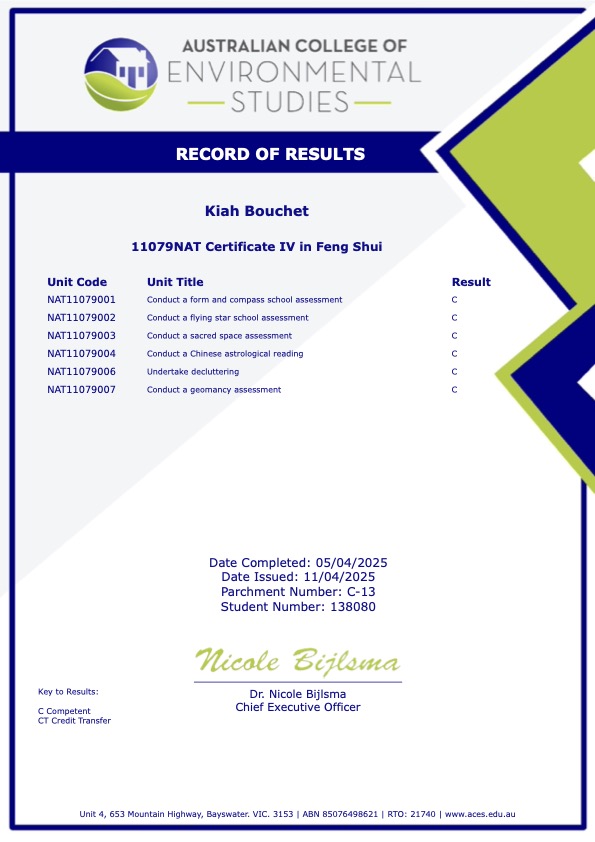
But becoming an accredited Feng Shui consultant takes more than rearranging furniture or watching online tutorials. It requires dedicated study, hands-on training, and recognised accreditation.
Step 1: Understand the Foundations
Every consultant starts by building a strong theoretical base, covering:
- The Five Elements Theory — Wood, Fire, Earth, Metal, and Water
- Yin and Yang balance — achieving harmony through opposing forces
- The Bagua Map — mapping areas of a space to life aspects like wealth, career, and health
- Qi (Chi) flow — how energy moves through spaces
- Form School and Compass School Feng Shui — classical approaches analysing landforms and directional energies
Step 2: Study With a Recognised School
In Australia, the most respected pathway is through the Australian College of Environmental Studies (ACES). As a government-accredited institution, ACES offers a Certificate IV or Diploma in Feng Shui covering classical systems like Flying Stars and Eight Mansions, energy balancing, supervised case studies, and professional ethics — all recognised by the Association of Feng Shui Consultants (AFSC).
International options like the International Feng Shui Guild (IFSG) also exist, but for Australian practitioners, ACES is the gold standard.
Step 3: Obtain Professional Accreditation
After completing your course, join a professional body such as the AFSC or IFSG. Accreditation shows clients you’ve completed certified training, follow a code of ethics, and are committed to ongoing development — separating serious practitioners from self-proclaimed experts.
Step 4: Gain Hands-On Experience
Practical experience is just as important as theory. This means completing required case studies, offering consultations to friends or family, shadowing senior practitioners, and building a portfolio of client reports.
Step 5: Continue Your Development
Feng Shui is a lifelong study. Many practitioners expand into complementary areas such as Bazi (Four Pillars of Destiny), Space Clearing, and Environmental Psychology — staying connected with professional organisations to remain current and supported.
Why Accreditation Matters
In a field where anyone can claim expertise, accreditation gives clients real confidence. Studying with a recognised institution like ACES ensures you graduate with both deep traditional knowledge and a qualification that carries genuine professional weight — setting the foundation for a meaningful, credible career.