
If you're new to Feng Shui, this is the question that arrives right after the excitement.
You've cleared a surface. Moved a plant. Read that the wealth corner should be tidy, and tidied it. And now you're standing in your hallway wondering: is this actually working?
It's a fair question, and most Feng Shui writing never answers it. So here's how I actually tell.
There are two readings to take, and they have to agree.
The first reading: what your senses say
Before any compass, before any calculation, I notice what a house does to me the moment I walk in.
Clutter and chaos give your brain nothing to settle on. When a room is full — everything vertical, edge-on, no space around anything — your eyes can't find a resting place. And when your eyes can't rest, your body doesn't either. You create tension simply by looking at it.
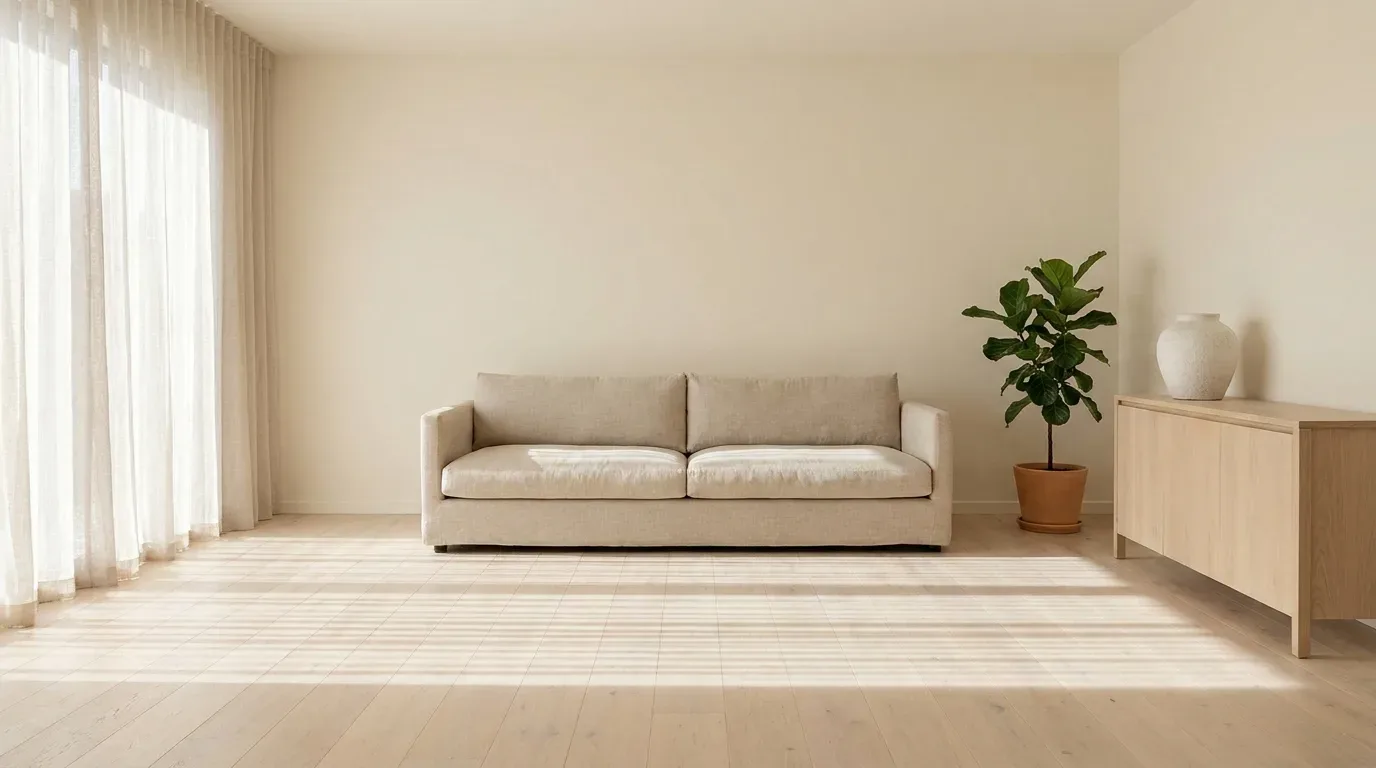
That's the sensory layer, and it happens before Feng Shui even enters the conversation. To settle into a calm, harmonious brainwave state — the relaxed, receptive one, not the alert one — you need a level plane to work from. A calm horizontal line. Clear surfaces, space around objects, somewhere for the eye to land and stop.
Then there's the other kind of sensory load: the smell you've stopped noticing, the background hum, the rough texture you brush past twenty times a day, the visual noise of too many competing things. All of it registers, even when you've tuned it out.
And underneath that: rooms hold what happened in them. If a room has hosted twenty years of arguing, no cushion arrangement is going to fix it. That isn't decoration. That's atmosphere, and it needs a different kind of attention.
The second reading: what your life says
This is the one people forget, and it's the more honest of the two.
Ask yourself:
- Is there one area of my life that simply won't move — an obstacle that keeps reappearing no matter what I do?
- Since I moved into this house, have things shifted? More accidents? Legal trouble? More arguments in my relationships?
- Is there a theme that started around the time I arrived here and never quite left?
Those aren't coincidences to explain away. They're the telltale signs that something in the home is blocked and asking for attention.
Where the two readings meet
Here's the useful part: the senses tell you that something is wrong. Your life tells you where.
If an area of the house feels stuck — no flow, no peace, oppressive to walk into — that's the room to look at. But you also want to know which aspect of life it corresponds to. Wealth? Marriage and love? Travel? Health?
That's where the calculation begins. We take a compass reading of your facing direction, and from that one measurement we map the rest: nine sectors, each covering a direction — north, north-east, east, and around. The ninth is the centre of the house.
The centre — the gut of the home
The centre sector is the one beginners overlook, and it's the one I care about most.
Think of it as the gut of the house. And the gut and the mind are connected in a way we all intuitively know: if your gut isn't right, you're suffering. If your head isn't right, you're suffering. You can't really fix one without the other.
So when there's ongoing illness in a household, one of the first things I ask is: what's happening in the centre of this home? Is something activating it constantly? And if it is — can it be turned off?
Often the answer is remarkably simple. Something has been sitting in the middle of the floor plan for years, quietly working against the people living around it.
So — does your house have good Feng Shui?
The honest answer is that it's never a look. A house can be beautiful and still not support you. It can be small and unremarkable and feel like a deep breath.
You know you have good Feng Shui when both readings agree: the space settles you when you walk in, and your life isn't caught in a repeating pattern that began when you arrived.
If one is true and the other isn't, that's not a verdict. It's a direction to look.
Three things to do this week
- Walk in and notice your body. Not the decor — your shoulders, your jaw, your breathing. Where do they change?
- Name the one stuck area of your life. Then walk the house and find the corner that feels the same way.
- Clear the centre. Whatever sits in the middle of your floor plan — a table piled with paper, a box you've stopped seeing — start there.
If you'd like a proper reading — the compass work, the nine sectors mapped to what's actually happening in your life — that's exactly what I do.